
ICC Prosecutor Requests Arrest Warrant for Myanmar’s Military Leader
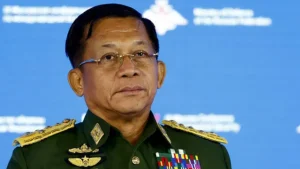
The International Criminal Court (ICC) has formally requested an arrest warrant for Myanmar’s military leader, Min Aung Hlaing, on charges of crimes against humanity targeting the Rohingya Muslim population.
Chief Prosecutor Karim Khan announced that there is sufficient evidence to hold Min Aung Hlaing accountable for the widespread persecution and forced deportation of the Rohingya people to Bangladesh. These events were part of a violent campaign in 2017 that forced hundreds of thousands of Rohingya to flee Myanmar. The United Nations has described the military’s actions during this period as genocide, although Myanmar’s government has consistently denied the allegations, claiming its operations targeted Rohingya militants.
 The crisis began after attacks by Rohingya militants on multiple police posts in Myanmar in 2017. The military’s response involved burning villages, killing civilians, and committing atrocities. According to Médecins Sans Frontières (MSF), at least 6,700 Rohingya, including 730 children under five, were killed within the first month of violence. Amnesty International also documented widespread sexual violence against Rohingya women and girls.
The brutality against the Rohingya drew international condemnation and demands for accountability. However, efforts were hindered as Myanmar, not being a signatory to the ICC, initially appeared beyond the court’s jurisdiction. ICC prosecutors later justified their investigation by noting that the deportation of Rohingya into Bangladesh—a member of the ICC—provided a legal basis for action.
After a five-year investigation, the ICC prosecutor has submitted evidence requesting an arrest warrant for Min Aung Hlaing. The decision now rests with a panel of three ICC judges. Meanwhile, a separate genocide case against the Myanmar military is ongoing at the International Court of Justice.
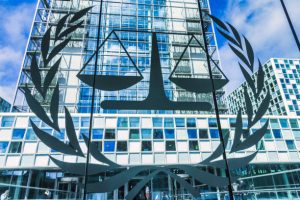
The Hague, Netherlands – april 19 2016: the logo of the ICC international criminal court at the entrance infront of the building itself.
Human rights groups have welcomed the development. Maria Elena Vignoli, senior international justice counsel at Human Rights Watch, called the move a “powerful warning” to Myanmar’s military leaders. Tun Khin, president of the Burmese Rohingya Organisation in the UK, described it as a “significant step towards justice and accountability.”
Min Aung Hlaing, who seized power in a 2021 coup against Myanmar’s elected government, is unlikely to face trial in The Hague, given his status as an international pariah and limited travel. His army, now embroiled in a civil war, has suffered heavy losses. Nonetheless, for the hundreds of thousands of Rohingya living in dire conditions in refugee camps in Bangladesh, the ICC’s actions signal that their plight has not been forgotten.